The Road to the Cross Starts Here

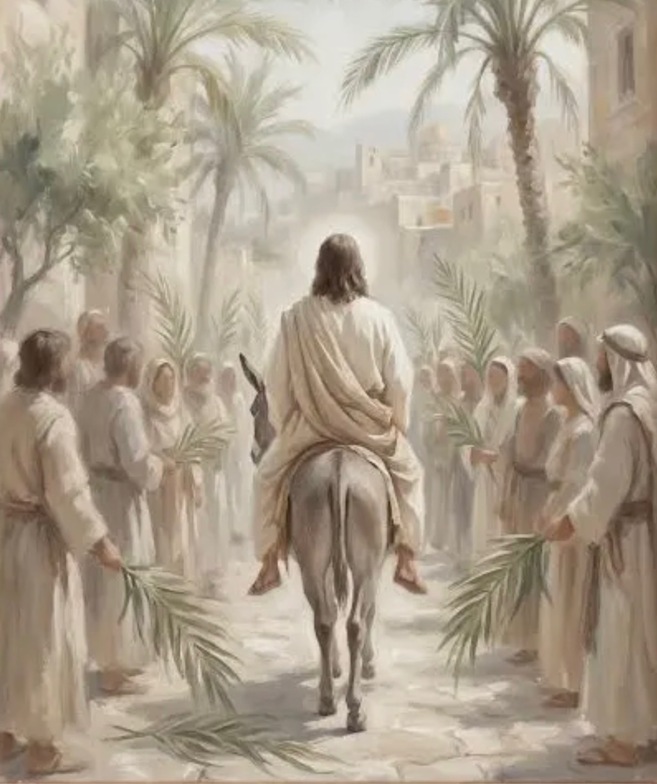
Sunday: The Triumphal Entry
Palm Sunday
Jesus is making His way into Jerusalem to celebrate what would be His final Passover. This would be the week that God would allow the vicious “plans” of the religious leaders to overtake Jesus. All of this in God’s timing and providence.
The city was crowded as many had traveled to take part in the festivities of the week. Jesus sent two disciples ahead, saying to them, “Go into the village opposite you, and immediately you will find a donkey tied there and a colt with her; untie them and bring them to Me. 3 If anyone says anything to you, you shall say, ‘The Lord has need of them,’ and immediately he will send them.” (Matthew 21:2-3 NASB)
Jesus sat on this colt or donkey to ride into Jerusalem, fulfilling the prophecy of Zechariah:
“Rejoice greatly, O daughter of Zion!
Shout in triumph, O daughter of Jerusalem!
Behold, your king is coming to you;
He is just and endowed with salvation,
Humble, and mounted on a donkey,
Even on a colt, the foal of a donkey.” (Zechariah 9:9 NASB)
As Jesus approached the city, the people spread their coats and clothes over the pathway in adoration. They cut and placed palm branches over the road as the King made His way into Jerusalem, hence calling it Palm Sunday.
As He approached the Mount of Olives, the entire crowd of disciples began to praise God joyfully, shouting:
“Blessed is the King who comes in the name of the Lord;
Peace in heaven and glory in the highest!” (Luke 19:38 NASB)
Blessed is the coming kingdom of our father David;
Hosanna in the highest!” (Mark 11:10 NASB)
10 When He had entered Jerusalem, all the city was stirred, saying, “Who is this?” 11 And the crowds were saying, “This is the prophet Jesus, from Nazareth in Galilee.” (Matthew 21:10-11 NASB)
17 So the [a]people, who were with Him when He called Lazarus out of the tomb and raised him from the dead, continued to testify about Him. 18 For this reason also the [b]people went and met Him, because they heard that He had performed this [c]sign. 19 So the Pharisees said to one another, “You see that you are not doing any good; look, the world has gone after Him.” (John 12:17-20 NASB)
Quoting Psalm 118:26, they hailed Jesus as Messiah. As the whole of the city was cheering Him, the Pharisees were furious and offended. In their jealous rage, they demanded that Jesus tell these good folks to stop honoring Him and offering worship to Him.
Jesus responds to the Pharisees with a strong claim of deity:
40 … “I tell you, if these become silent, the stones will cry out!” (Luke 19:40 NASB)
Scripture often speaks of inanimate nature praising God (below). Here Jesus tells them, if not the people, then the natural creation will cry out to worship Me, their creator.
Psalm 96:11-12
11
Let the heavens be glad, and let the earth rejoice;
Let the sea roar, and all it contains;
12
Let the field exult, and all that is in it.
Then all the trees of the forest will sing for joy
Psalm 98:7-8
7
Let the sea roar and all it contains,
The world and those who dwell in it.
8
Let the rivers clap their hands,
Let the mountains sing together for joy
Isaiah 55:12
12
“For you will go out with joy
And be led forth with peace;
The mountains and the hills will break forth into shouts of joy before you,
And all the trees of the field will clap their hands.
Psalm 148 is dedicated to showing how all of creation is invoked to praise the Lord; the heavens, sun and moon, stars, water, sea monsters, fire and hail, snow and clouds, cedars, beasts and cattle, creeping things, and birds are all worshiping and praising their creator God, Jesus Christ. Jesus was right to tell those leaders that creation will raise its hands and its heart to the king.
41 When He approached Jerusalem, He saw the city and wept over it, Luke 19:41 (NASB)
Luke is the only one who records Jesus weeping over Jerusalem. This may seem unusual or even misplaced, considering it’s a joyous occasion. However, it reveals that Jesus truly understood the superficiality of the people’s hearts. His mood was anything but joyful as he entered the city.
This same crowd that shouted “Hosanna” and gave Him glory will soon cry for His death.
Jerusalem was under divine judgement and the destruction of the city was set into motion for their failure to recognize & embrace their Messiah when He visited them.
Jesus, not in the mood for celebration, observed the crowd’s lack of genuine praise for Him as their Savior. Their hearts were still burdened by unrepentant sin and anguish. He wept in compassion for both, the impending judgment, and the events of the week, knowing that this same cheering crowd would soon send Him to the cross.
11 “Jesus entered Jerusalem and came into the temple; and after looking around at everything, He left for Bethany with the twelve, since it was already late.” (Mark 11:11 NASB)
Palm Sunday was filled with empty adoration and hateful enemies as Jesus rested one more day before fulfilling His work.