Jesus Choses To Go to the Cross

FRIDAY
Early betrayal in the Garden of Gethsemane Mark 14:43-50
Jesus questioned & mock trial John 18:12-24
Peter’s denials John 18:15-27
Trial before Pilate & Herod Luke 23:1-12
Jesus sentenced to death Luke 23:13-25
One the cross between two thieves Mark 15:16-27
The burial in a rich man’s tomb John 19:31-42
It was late, after midnight, while Jesus was chastising the disciples for falling asleep while they should have been praying. Judas “came up accompanied by a large crowd with swords and clubs, who came forth from chief priests and elders of the people” (Matthew 26:47) to arrest the one Judas would kiss. “And Jesus said to them, “Have you come out with swords and clubs to arrest Me, as you would against a robber? Every day I was with you in the temple teaching, and you did not seize Me; but this has taken place to fulfill the Scriptures” (Mark 14:48-49). At this point, just after midnight Friday morning, all of His disciples deserted Jesus. He was seized by the guards & slaves of the chief priests.
Jesus was shackled and dragged away to attend a mock trial by the high priest’s house, first to Annas, then to Caiaphas, gathered with scribes and the elders. The manner in which it was conducted was totally against any Jewish law written. A trial was not to be held in secret, and the accused would have time to accumulate witnesses; however, the Jewish leaders did not want a fair trial. “Now Caiaphas was the one who had advised the Jews that it was expedient for one man to die on behalf of the people” (John 18:14) calling for false witnesses to gather. But none of the false testimonies could agree with each other to make their case. Since none of the false testimonies would stick, Jesus was accused of blasphemy since He claimed to be the Christ saying “I am; and you shall see the Son of Man sitting at the right hand of Power, and coming with the clouds of heaven” (Mark 14:62). This was the admittance they needed to seek the death penalty from the Roman authorities.
Peter watched and wept from a distance as they mocked and beat his savior, cowering as he denied Jesus’ name three times just as predicted by the Messiah. The night was cold and dark as Jesus was chained until first light to go before Pilate. “Now when morning came, all the chief priests and the elders of the people conferred together against Jesus to put Him to death; and they bound Him, and led Him away and delivered Him to Pilate the governor.
Then when Judas, who had betrayed Him, saw that He had been condemned, he felt remorse and returned the thirty pieces of silver to the chief priests and elders, saying, “I have sinned by betraying innocent blood.” But they said, “What is that to us? See to that yourself!” And he threw the pieces of silver into the temple sanctuary and departed; and he went away and hanged himself” (Matthew 27:1-5).
They brought Jesus before Pilate seeking the death penalty however Pilate found no guilt in Him. The Jewish leaders were insisting of His guilt, “Pilate learned Jesus belonged to Herod’s jurisdiction, he sent Him to Herod” (Luke 23:7). Herod had been longing to meet Jesus, seeking to see signs and miracles from Him. Jesus kept silent. Herod sent Jesus back to Pilate to make the decision on the man. Pilate offered, as accustomed, to release Jesus or the murderer Barabbas, but the Jewish leaders had already charged the crowd to crucify Jesus. Pilate was perplexed because of the lack of guilt he found in Jesus, that he proposed Jesus to be scourged as punishment, but not deserving of crucifixion. As Pilate is contemplating this situation, his wife sends note to him saying “Have nothing to do with that righteous Man; for [a]last night I suffered greatly in a dream because of Him” (Matthew 27:19).
“Pilate, wanting to release Jesus, addressed them again, but they kept on calling out, saying, “Crucify, crucify Him!” And he said to them the third time, “Why, what evil has this man done? I have found in Him no guilt demanding death; therefore I will punish Him and release Him” (Luke:20-22). The scripture does not go into any great detail of Jesus’ scourging; however, the Roman scourging was quite brutal. A beating of weapons, including rods, chains, leather whips latched to metal spikes, and sharp bone, was used to tear the flesh. Exposing muscle and bone, swelling, and pain were given by trained Roman soldiers. “They stripped Him and put a scarlet robe on Him. And after twisting together a crown of thorns, they put it on His head, and a reed in His right hand; and they knelt down before Him and mocked Him, saying, “Hail, King of the Jews!” They spat on Him, and took the reed and began to beat Him on the head” (Matthew 27:28-30). “After they had mocked Him, they took the purple robe off Him and put His own garments on Him. And they led Him out to crucify Him” (Mark 15:20).
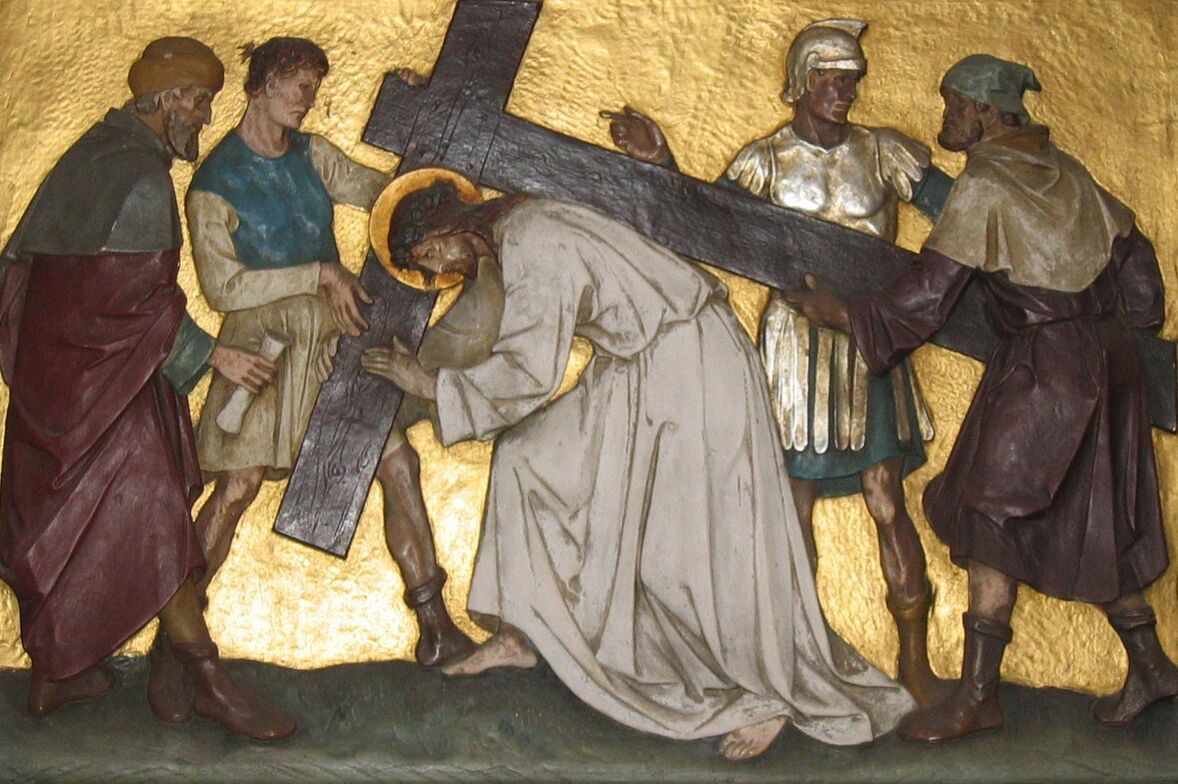
Jesus’ weak body was dragging His own cross to Golgatha, or The Skull. He began to move slowly, too slowly for the guard’s liking, so they implored the help of a passerby named Simon of Cyrene to help Jesus carry the cross. “And following Him was a large crowd of the people, and of women who were [a]mourning and lamenting Him” (Luke 23:27). Others were yelling and spitting on Jesus as He journeyed to His death place. Driving one nail through His left wrist and another nail through His right wrist, they laid His beaten body on the tree. Strapping His feet crossed over each other for the hammer to drive the third nail through both of His ankles, with every strike of the hammer shaking throughout Jesus’ already bleeding, bruised, swollen, bare body. They hoisted Jesus up, dropping the bottom of the cross in a hole deep enough to hold Him up in the air. With one criminal on the left and another criminal on the right. “But Jesus was saying, “Father, forgive them; for they do not know what they are doing.” And they cast lots, dividing up His garments among themselves” (Luke 23:34).
Jesus endured the mocking and spitting, even refusing the offering of drink designed to be terrible in taste and maybe dull some of His senses. As the inscription above Him read, “THIS IS THE KING OF THE JEWS” (Luke 23:38), His mother, Mary, along with other disciples, watched and heard all of the suffering of the Messiah. The anguish was indeed great as the onlookers cared for Jesus and the mockers laughed, waiting for Him to call down angels and Elijah to save Him. Even though He could call down legions of angels to help Him, this was not the plan of the Savior. The plan of the Savior was to take the wrath of God for the sins of the world. As the sky drew dark, “darkness fell over the whole land until the ninth hour (three o'clock)” (Luke 23:44), the wrath of God fell on our Savior in order for Him to carry out His mission, giving believers reconciliation to Holy God. “When the sixth hour came, darkness fell over the whole land until the ninth hour. At the ninth hour Jesus cried out with a loud voice, “Eloi, Eloi, lama sabachthani?” which is translated, “My God, My God, why have You forsaken Me?” (Mark 15:33-34) “And Jesus, crying out with a loud voice, said, “Father, into Your hands I commit My spirit.” Having said this, He breathed His last. Now when the centurion saw what had happened, he began praising God, saying, “Certainly this man was innocent” (Luke 23:46-47). “And behold, the veil of the temple was torn in two from top to bottom; and the earth shook and the rocks were split” (Matthew 27:51).
“Then the Jews, because it was the day of preparation, so that the bodies would not remain on the cross on the Sabbath (for that Sabbath was a high day), asked Pilate that their legs might be broken, and that they might be taken away. So the soldiers came, and broke the legs of the first man and of the other who was crucified with Him; but coming to Jesus, when they saw that He was already dead, they did not break His legs. But one of the soldiers pierced His side with a spear, and immediately blood and water came out” (John 19:31-34).
Jesus’ body had to be off the cross before the ninth hour (six o’clock) because Jews could not handle the dead or do any work on the Sabbath to keep it holy. And they did not want Him to stay on the cross the entire day; therefore, they respectfully hurried to get the man they cared about and honored buried.
“After these things Joseph of Arimathea, being a disciple of Jesus, but a secret one for fear of the Jews, asked Pilate that he might take away the body of Jesus; and Pilate granted permission. So he came and took away His body. Nicodemus, who had first come to Him by night, also came, bringing a mixture of myrrh and aloes, about a hundred pounds weight. So they took the body of Jesus and bound it in linen wrappings with the spices, as is the burial custom of the Jews. Now in the place where He was crucified there was a garden, and in the garden a new tomb in which no one had yet been laid. Therefore because of the Jewish day of preparation, since the tomb was nearby, they laid Jesus there” (John 19:38-42).
“It was the preparation day, and the Sabbath was about to begin. Now the women who had come with Him out of Galilee followed, and saw the tomb and how His body was laid” (Luke 23:54-55).
“And Mary Magdalene was there, and the other Mary, sitting opposite the grave” (Matthew 27:61). Then they returned and prepared spices and perfumes.” (Luke 23:56).
This was the beginning of a long, sorrowful evening. Emotions only believers would anguish and re-live in remembrance of Jesus Christ.